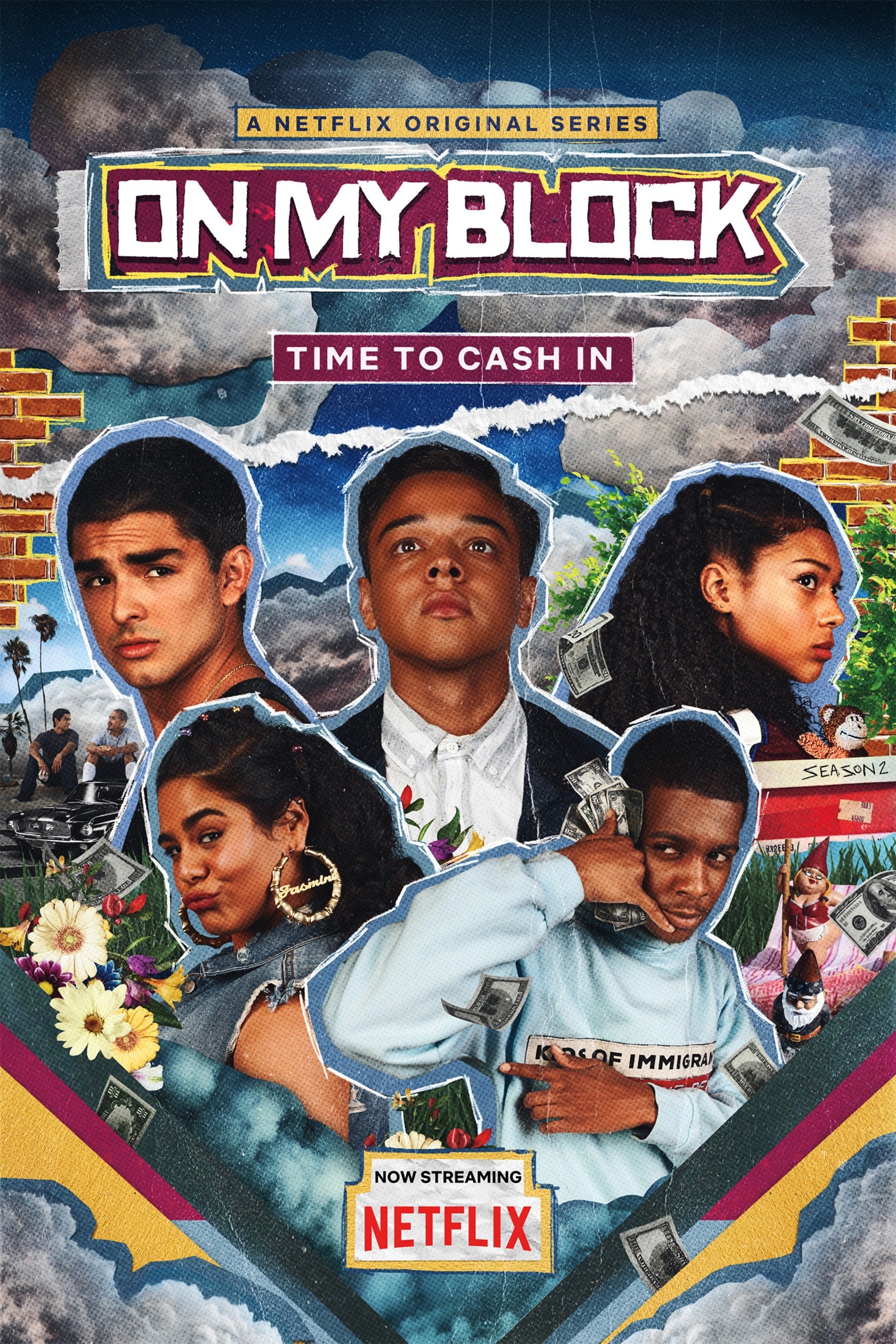
So, you've probably spent way too much time scrolling through Netflix, seeing that familiar bandana-clad logo and wondering if the hype around the On My Block Santos is actually worth it. Honestly? It is. But not for the reasons you might think. Most shows treat gang culture like a cardboard cutout—just some guys in baggy clothes looking mean for the camera. On My Block did something different. It made the Santos feel like a living, breathing, and terrifyingly permanent part of the Freeridge ecosystem.
The Santos aren't just the "bad guys" in this story. They are the story.
When people talk about the On My Block Santos, they usually start with Spooky. Oscar "Spooky" Diaz, played by Julio Macias, basically redefined what a "gang leader" character looks like on modern TV. He wasn't just a villain. He was a brother. He was a victim of his own environment. He was a guy who wanted out but knew the gravity of the streets wouldn't let him go without a fight. If you’ve watched the show, you know that the Santos represent the shadow hanging over Monse, Ruby, Jamal, and Cesar. It’s a shadow that doesn’t just disappear because you graduate middle school.
What People Get Wrong About the Santos Hierarchy
A lot of fans think the Santos are just a disorganized group of neighborhood kids, but the show subtly maps out a much more rigid structure. It’s based on real-world Southern California gang dynamics, even if it’s fictionalized for TV. You have the "O.G.s" who call the shots from the background or from prison, the "Shot Callers" like Oscar, and the "Pee-wees" or "Lil' Homies" like Cesar was supposed to be.
The pressure on Cesar to join the On My Block Santos wasn't just a plot point; it was a representation of the generational trap. His dad was in. His brother was the leader. In that world, saying "no" isn't just an option—it's a betrayal of blood.
Most viewers missed the subtle details in the set design of the Santos' hangouts. The graffiti isn't random. The colors aren't just for show. The showrunners worked hard to ensure that the visual language of the Santos felt authentic to the L.A. landscape. It’s why the show resonates so deeply with people who actually grew up in those neighborhoods. They see the nuances. They see the fear in Cesar's eyes when he puts on that shirt for the first time. It’s heavy stuff.
The Spooky Factor: Why Oscar Diaz Changed Everything
Let's be real for a second. Julio Macias stole the show. When we first meet Oscar, he’s terrifying. He’s shirtless, covered in ink, and looks like he’d kill you for breathing wrong. But by the time we get to the later seasons, he’s the heart of the show. That transformation is why the On My Block Santos became such a focal point for the fandom.
🔗 Read more: Jack Blocker American Idol Journey: What Most People Get Wrong
He showed the cost of the life.
There's a specific scene where Oscar talks about the "Santos legacy" and how it’s basically a death sentence. It’s one of the few times a show actually acknowledges that gang life isn't glamorous—it's exhausting. You’re always looking over your shoulder. You’re always waiting for the other shoe to drop. The Santos aren't just a gang; they're a cycle.
The Rivalry: Santos vs. Prophets
You can't talk about the Santos without mentioning the Prophets. This wasn't just some petty beef. This was a war for territory that dictated where the main characters could even walk. The introduction of the Prophets raised the stakes for the On My Block Santos because it showed that as tough as Spooky was, there was always someone crazier.
The RollerWorld money—the legendary $50,000—was the catalyst for everything. It’s what everyone wanted, but it’s also what caused the most blood. The way the Santos handled the threat of the Prophets showed their tactical side. It wasn't just about shooting; it was about outmaneuvering. It was about survival.
Think about the Cuchillos arc. That woman was terrifying. She held the Santos in the palm of her hand, proving that even at the top of the local food chain, there’s always a bigger fish. The Santos weren't the kings of the world; they were pawns in a much larger, much darker game.
Why the Santos Identity Matters to the Fans
Gangs in media are usually faceless. You see them in the background of Law & Order episodes or as cannon fodder in action movies. But the On My Block Santos have names. They have families. They have jokes. They have moments of vulnerability that make you forget, just for a second, that they’re involved in high-level crime.
💡 You might also like: Why American Beauty by the Grateful Dead is Still the Gold Standard of Americana
This humanization is why the "Free Cesar" movement within the show felt so urgent. We weren't just rooting for a kid to stay out of trouble; we were rooting for him to break a curse. The Santos represent that curse. They are the physical manifestation of the systemic issues that keep kids in places like Freeridge from reaching their potential.
- The tattoos tell a story of time served and brothers lost.
- The hand signals aren't just cool gestures; they’re a language.
- The loyalty is absolute, even when it’s toxic.
It’s complex. It’s messy. It’s exactly like real life.
The Legacy of the Santos in the Spin-off
When Freeridge (the spin-off) dropped, people were looking for the Santos. While the tone of the new show was different—more supernatural, more quirky—the legacy of the On My Block Santos still loomed large. You can't tell a story in that neighborhood without acknowledging the power vacuum left behind after the events of the original series.
The Santos changed the way we look at teen dramedies. They added a layer of "real stakes" that Pretty Little Liars or Riverdale could never touch. In Freeridge, if you mess up with the Santos, you don't just get a mean text message. You lose everything.
That sense of danger is what kept us clicking "Next Episode" at 3:00 AM.
Moving Toward a Real Understanding of Freeridge
If you're looking to dive deeper into the world of the On My Block Santos, you have to look past the surface-level violence. Look at the relationships. Look at how the gang provides a sense of "family" to kids who don't have one at home. It’s a tragic reality that the show handles with incredible grace and sharp humor.
📖 Related: Why October London Make Me Wanna Is the Soul Revival We Actually Needed
The Santos aren't just a plot device. They are a reflection of a reality for millions of people.
To really appreciate the writing, pay attention to the dialogue in the scenes where the gang members are just "hanging out." The slang is precise. The rhythm of the speech is authentic. It doesn't feel like a 40-year-old writer in a boardroom trying to sound "urban." It feels like Freeridge.
Actionable Insights for Fans and Writers
If you’re a fan or a creator looking to understand why the Santos worked so well, here are the key takeaways:
- Character over Archetype: Don't write a "gang member." Write a brother who feels forced into a role he hates. That's why Spooky worked.
- Consequences are Key: In On My Block, every action involving the Santos had a permanent consequence. Characters died. Relationships broke. Nothing was "reset" at the end of the episode.
- The Environment is a Character: Freeridge itself dictates the behavior of the Santos. The geography of the neighborhood—where the turf starts and ends—is as important as the script.
- Humor in the Dark: The show used humor to make the threat of the Santos more palatable without stripping away their teeth. It’s a delicate balance that very few shows get right.
The On My Block Santos will go down as one of the most well-realized fictional gangs in television history. They weren't just there to be scary; they were there to show us the heart, the pain, and the impossible choices of life in the inner city.
Next time you rewatch, keep an eye on the background characters. Notice how the neighborhood reacts when a Santos member walks into the room. It’s all there. The fear, the respect, and the deep, underlying sadness of a cycle that never seems to end. That is the true story of the Santos.